Schooling, Detours, and Launch — What Debbie Would Do (and Not Do) Again
In this short solo episode, I’m responding to a question I hear from so many parents navigating unconventional education paths: looking back, what would I change—and what wouldn’t I—about my twice-exceptional young adult’s schooling journey. I share why there’s no perfect path, what I’m glad we did (including embracing flexibility and a gap year), and how I’ve learned to let go of timelines and trust that our kids are on their own trajectory—even when it looks different from everyone else’s.
About Debbie
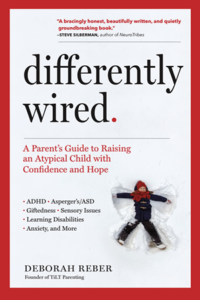
 Debbie Reber, MA is a parenting activist, bestselling author, speaker, and the CEO and founder of Tilt Parenting, a resource, top-performing podcast, consultancy, and community with a focus on shifting the paradigm for parents raising and embracing neurodivergent children. A regular contributor to Psychology Today and ADDitude Magazine, and the author of more than a dozen books for children and teens, Debbie’s most recent book is Differently Wired: A Parent’s Guide to Raising an Atypical Child with Confidence and Hope.
Resources mentioned
- Dr. Dan Peters Discusses the Teen Years & Preparing for Navigating Launch (Tilt Parenting Podcast)
- Best Gap Year Programs for Neurodivergent Students (Thrive Autism Coaching)
- Dr Eric Endlich on Gap Programs for Neurodivergent Students (Tilt Parenting Podcast)
- Debbie Talks About Her Transition to Homeschooling (Tilt Parenting Podcast)
Want to go deeper?

The Differently Wired Club is not your typical membership community.
There’s something here for everyone, whether you’re a sit back and absorb learner, a hands-on, connect and engage learner, and everything in between. Join the Differently Wired Club and get unstuck, ditch the overwhelm, and find confidence, connection, and JOY in parenting your differently wired child.
Learn more about the Differently Wired Club
Episode Transcript
Debbie:
I’m answering a question that I got sent to me and it’s representative of a question I hear from parents a lot and that is, now that my child is 21 years old has launched into a university experience and knowing how unconventional our schooling and my kid’s childhood was, is there anything that we would have changed, anything that we would not have changed? Before I even get into it, I’m going to say upfront that I’m very, very conscientious of respecting my young adult privacy.
So if you’ve been with the show for a very long time, you know that my kiddo and I launched Tilt together 10 years ago with the Facebook Live and also Ash was a guest on multiple podcast episodes. a lot of y’all feel like you know my child and you do. You have that kind of glimpse into who my kid was at that time. But now as a young adult, I’m going to leave my child out of this and I’m going to focus on me.
So looking back on the schooling journey, many of you guys know that we did have multiple school experiences. couple of different preschools and then kindergarten and half of first grade was in one private school and that was a messy breakup and then the second half of first grade was in another private school and that ended even though we weren’t ready to break up we were broken up then second grade was a public school but in a full-time gifted program with an IEP and additional supports.
And then after that, our entire family moved to the Netherlands from Seattle. And then that was the start of our homeschooling journey, which I ended up doing for six years. And then high school was an alternative private high school, which had a unique model, was actually a one-to-one learning model. Then a gap year, and now year two of a very rigorous traditional in the UK system traditional university. So that’s what it looked like.
So looking back, I definitely would not change any of the big decisions that we made along the way. I was following, you know, the advice that I share with so many parents now and approaching my child’s schooling with curiosity and with nimbleness and being responsive to what is happening right now. So I say this a lot, but it’s very few of us that are gonna find a school fit early on in our kids’ journey, their 10 years down the road, they’re still in the same program, right? Our kids are always changing, their needs are always changing, environments change, and sometimes what worked really well for a period of time stops working. And so it really behooves us to be responsive to what is happening on the ground and being willing to always step back and saying, is this still a good fit? Is my child safe here? Is my child being supported? Is my child’s love of learning continuing to grow? All of those things.
So looking back, if I had mapped it out what I wish that we had had all of those different academic environments and school changes and big transitions. No, that was not on my bingo card of what I wanted to have happen. And I wouldn’t have changed it. Because it was being responsive to what needed to happen at that time, even though at the time I was making those decisions, I didn’t know if it was the right choice. Also, right, I’m using air quotes, there’s no right choice. So just learning that has been a big part of my own personal growth. What I might change is the amount of pressure that I put on myself while making those decisions. I really felt, especially at those kind of first pivots from the traditional path, I felt like this is make or break it. I’ve gotta get this right or I might completely be screwing up my child’s future. So I put a lot of pressure on myself. I lost a lot of sleep. and I just felt this intense weight that I needed to get this right. So just to reiterate what I just said, I now know and I deeply believe that there is no perfect school. There’s no perfect elementary school, middle school, high school, even post-secondary choice that is guaranteed to work for any child or that it’s this hands down better than everything else. Every path that we choose involves trade-offs. So if we can go into those changes, being, again, curious and open to my favorite words, then we’re going to be better able to respond to what happens and to not kind of put pressure on that thing as being the solution or the fix, right, that’s going to get our kids from A to B without any challenges.
Another part of our journey was that we embraced the idea of a gap year and we did that pretty early on and that is something I definitely would not change. kind of always in the back of my mind knew that a gap year was probably going to happen just because, you know, we know our kids have kind of long runways and I knew that giving more time for development and growth and maturity and all of those things was certainly not going to hurt my child and would most certainly benefit my child. So I had that in the back of my mind. And when we got to the point where we were exploring what’s next and, is it time to be applying to schools, to universities and colleges, it was pretty clear that, OK, this is a lot. Right now, we’re going to push pause on that. We’ll come back to it. we’ll take a year to get clarity, to build a readiness, to mature, to bring nervous system regulation back down to a good calmer baseline after the anxiety of taking the ACT and taking AP tests and all the things that are involved in high school. So I’m really, really glad that we embraced that idea of a gap year.
And I also believe that delaying can be a really good thing. And I would much rather our young person be a little bit older than their peers in a college or university setting, then being pushed forward before they’re really ready. For so many of our kids, it’s already such a huge leap to go from living at home and going to school to moving into a post-secondary education situation, whether they’re living at home or they’re living elsewhere. There’s a lot to be grappling with and to figure out and to sort and to navigate. So the more mature our kids are when they do that, I think the better.
Another thing looking back on, I think I had this idea that I could fully prepare for everything. especially taking that extra time, that gap year is going to give us an opportunity to make sure these executive function skills nailed, right? We got all the systems in place and my child has all the skills and all the support set up and feeling that sense that, okay, I can really that the launch isn’t super messy. So looking back, even with two years now perspective, I’m really in acceptance of the fact that there’s just no way to prepare kids for everything. There’s no way. No matter what we do, no matter all the things we put in place and the research we do and the programs and the planning, it’s going to be messy. I think, you know, going back, I wish my current self could tell myself of two to three years ago, hey, chill out, it’s gonna be okay, it’s gonna be messy, but you’ll figure it out. Don’t run yourself ragged trying to preemptively solve all of the problems, because we don’t know what the problems are going to be. And we can’t control the future. And you’re gonna really burn yourself out. So, and then going back to that initial question about the school choices, right? We did have a very unconventional path and I do feel like we made the right decisions.
In some cases, we didn’t really have a lot of options. You know, when we moved to the Netherlands, it was for my husband’s job and we couldn’t find a private school that was willing to support my kids’ neurodivergence. So homeschooling, it was a lot to sort. And I think I always was wondering, what is this going to mean for my child’s future possibilities? Am I narrowing what’s possible down the road? Or how do I make sure that everything’s still available and my child doesn’t have any doors closed in terms of pursuing careers or programs down the road?
So part of this has just been like, yeah, this wasn’t the kind of traditional preparation. A student who’s in a more traditional educational setting where they’re navigating multiple classes and multiple assignments and group projects and all of the kind of social dynamics and stressors of a typical high school, that wasn’t part of my kid’s experience. And so I had to kind of weigh the balances. Is it worth it? for my child not to have those experiences and then go on to what’s next, not perhaps being as prepared for some of the unique challenges of university as a child who had a more traditional background. And ultimately, yeah, it was worth it. It was the best path for us at any given time. And I’m not someone to say everything happens for a reason, I do believe that there’s learning in everything. So, and again, just being responsive on the ground at all times is really the best bet that we have for our kids who are always changing and their nervous systems and their needs and capacity is fluctuating constantly.
Then one last thing that I absolutely would not change. At any point as I was raising my kiddo, whether it was homeschooling together or advocating in school systems or whatever we were doing scaffolding from afar during a gap program. I would not change that what I prioritized more than anything else was my relationship with my child and making sure that we were always staying on the same team that we were collaborating. But it always felt like, okay, this is our thing. to figure out this is our family’s thing to chart a path for. And we do not have to do this the way anybody else does. We get to do this on our own. You are a unique individual and there’s no one way this can look and there’s freedom in that we get to do this in a way that feels right for us. And that can feel really scary and uncomfortable. because there can be a lot of people on the sidelines wondering, what are you doing? How are you going to make this work? What about this? And that can be really hard to navigate, but I wouldn’t change a thing about that. Just trusting in the values that we have as a family and centering my child’s sense of feeling seen and loved and understood and nurturing that deep relationship. That was always the priority and I wouldn’t change a thing about that.
So before I wrap up, there were three things I just wanted to share because I’m still in this, right? My kiddo, again, is in year two at a pretty rigorous school in another country. I’ve got the North Sea between me and where my child is. And again, that learning curve for my child and learning how to be a student is pretty significant. And then I’m still in it. I’m still supporting and scaffolding and doing all the things. And it still is challenging for me. So I wanted to share the three things that I’m still kind of working on. I call them my growth edges. So the first is I am continuing to learn how to let go of control. And I think that’s especially hard for parents like us because for so many years, we are deeply, deeply involved in the advocacy work and the problem solving, we’re in the trenches, we are that kind of surrogate prefrontal cortex. And so learning how to really let go of that control a genuine way, that’s where my work is really happening right now.
The second thing that is a big area of ongoing growth for me is just figuring out how do I scaffold this kid from afar. Scaffolding, if that concept isn’t familiar to you, it is just that idea of, you know, creating supports that are kind of close to my kids own learning edge so that my child can continue to grow and learn and be pushed a little bit outside of a comfort zone while also not being pushed too quickly so that they crash and burn and it doesn’t work out, right? So I’m always trying to navigate, okay, what’s the right level of support in this moment so that my kiddo can continue to grow? Neither of us burn ourselves out. So. That’s been a real area for me to focus on supporting an individuating young adult while really respecting that young adult’s autonomy. Not my super comfort zone, but I am working on it.
And then the last thing, and this is just baked into the reality of raising a neurodivergent complex human is growing in my own capacity to tolerate uncertainty and to trust in the foundation that we have built. So I cannot see every step of the path, especially because my kid’s not at home. I don’t even know where the path is half the time. So how am I supposed to know what next steps to take or how to advise my child in which direction to go. A lot of this is about tolerating and that is the word tolerating uncertainty and just being like, okay, we did the best we could. I showed up as best I could for this human. I shared what I could share. We developed a lot of connection and growth together and I’m gonna trust in that foundation. And again, going back to those two words I shared earlier on, lean into curiosity and openness. I don’t know how this is gonna play out from day to day, let alone what next year or five years down the road is gonna look like. just stay committed to being in it, to not beating myself up if I made a decision or looking back, a choice feels like, might not have been the right thing. It was the best choice I could have made at that time. And there was learning in all of it.
So I hope that that is helpful for the person who submitted the question, but for any of you guys listening to this. I just want to acknowledge it’s really hard parenting an unconventional child in a conventional world. It just is. There’s no one way that this looks and there’s no playbook to follow to ensure to check off all the things and ensure that things unfold the way that we want. But just showing up in the moment day to day, prioritizing connection into curiosity and openness. That’s really the way to go. So thanks so much for listening and I will see you next time.
Do you have an idea for an upcoming episode? Please share your idea in my Suggestion Box.