Debbie Reflects on the Tilt Parenting Manifesto, 10 Years Later
Today’s episode is a little different—it’s just me, revisiting the Tilt Manifesto I wrote back in 2015 as part of my development of Tilt Parenting. In this solocast, I share the context in which that manifesto was born, what was happening in my own life as a parent of a neurodivergent child at the time, and why there felt like such an urgent need to challenge the dominant parenting narratives around compliance, productivity, and “normal.” This is a look back — and a look forward — rooted in gratitude, curiosity, and hope.
About Debbie
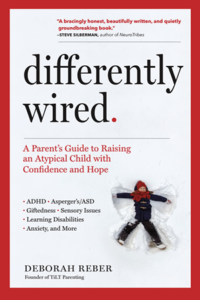
 Debbie Reber, MA is a parenting activist, bestselling author, speaker, and the CEO and founder of Tilt Parenting, a resource, top-performing podcast, consultancy, and community with a focus on shifting the paradigm for parents raising and embracing neurodivergent children. A regular contributor to Psychology Today and ADDitude Magazine, and the author of more than a dozen books for children and teens, Debbie’s most recent book is Differently Wired: A Parent’s Guide to Raising an Atypical Child with Confidence and Hope.
Resources mentioned
Want to go deeper?

The Differently Wired Club is not your typical membership community.
There’s something here for everyone, whether you’re a sit back and absorb learner, a hands-on, connect and engage learner, and everything in between. Join the Differently Wired Club and get unstuck, ditch the overwhelm, and find confidence, connection, and JOY in parenting your differently wired child.
Learn more about the Differently Wired Club
Episode Transcript
Debbie:
So I recently went back and reread the Tilt Manifesto, which I launched with when I first started Tilt Parenting. And before I even get into what it says, I wanted to talk about where I was when I wrote that because I think the context really matters. So I actually wrote it in the summer of 2015. My kid was almost 11 and away at summer camp in the San Juan Islands in the Pacific Northwest of the US. And I was spending a week on Bainbridge Island on a creative work retreat with my friend Alice. So I was in this real inbetween space, professionally, geographically, emotionally. And that week that I spent on that work retreat was really meant to get clarity about next steps. But also it was really about sitting with the uncertainty of what this was going to look like.
I was making my way through Jonathan Fields’ Revolution U program at the time. Jonathan is the man behind the Good Life Project podcast. Maybe you’ve listened to it. It’s great. And he had designed a program to help guide mission driven creators through a process of designing movement, right? That was really centered on purpose and values and what you’re actually here to build and to create. So that week in Bainbridge Island, I definitely felt what I wanted to do in the world and what I was creating and what would eventually become Tilt Parenting as a movement. That’s how I thought of it, a movement.
I was also still very much in the middle of parenting a kid who was not fitting into the standard mold. So in that summer of 2015, we had just finished our second year of homeschooling, and we were still very much kind of feeling our way through everything. I didn’t really know where exactly we were going. I didn’t have a great long term plan. I also didn’t really know if what we were doing was quote unquote working, whatever that word is supposed to mean when you’re raising a human being. But I did know that things were moving in the right direction. So it wasn’t necessarily a neat linear trajectory, but in this kind of deeper and subtle way, I noticed, OK, we’re on the right track here. My kid and I were connecting more. Our whole family was just working better together, we were collaborating more, we were making decisions together that felt really aligned, even if again, we didn’t know exactly what we were working towards or there were any guarantees that what we were doing would work.
I was seeing these sparks of positive change and I also felt more and more strongly every day that families like mine, that kids like mine deserved so much better than what we were getting. We deserved better than the narratives that told us our kids were problems to be fixed or systems that measured success in these kind of narrow arbitrary ways. And we deserve better than parenting advice that left us feeling ashamed or isolated or just like we were massively failing at what we were And I knew then, maybe before I even fully understood it, that if anything was going to change, it was going to have to start with us, with parents of neurodivergent kids, with people who were willing to kind of question the script, question everything and say, this is not working and we can do much better. So that’s the place where the Tilt manifesto really came from.
I had reached out to hundreds of parents navigating complex parenting journeys, and I asked them what wasn’t working in their family’s lives. And to me, it all felt super urgent. it was, it was, it is super Our kids’ lives are literally on the line here. Their ability to thrive and to feel whole and valued is what I was and what I still very much am talking about.
So that summer as I was drafting the manifesto, I didn’t have the language that I have now today, 11 years into the future. It just wasn’t even available to me or to us at the time. I didn’t have access to the research that we talk about all the time today. I also didn’t have 10 years of conversations with parents or interviews with experts and authors and thought leaders or community that helped to shape my thinking. But what I did have back then was this drive that this needs to change and a profound sense of just isolation.
I was searching everywhere for conversations that reflected what I was actually living as a parent and I couldn’t find them. And the beliefs that felt most true to me, the ones that I was starting to really kind of pull together in our own family, they just weren’t really out there. Or if they were, they were really buried kind of in the margins. It was hard to find the people who were having these same conversations. So I wrote about those ideas in the Tilt Parenting Manifesto.
Ideas like our kids are not broken. Behavior is communication. Relationships with our kids matter so much more than compliance. And those were not mainstream conversations back in 2015. And I remember thinking very clearly, why or maybe how is nobody talking about this stuff out loud? So that’s what I did. It’s really why Tilt Parenting started. Not because I had all the answers, but because I just saw there was this giant void, right? There was this gap between what parents like me were living and what the culture was offering us.
And the Tilt Manifesto was my attempt to build a bridge across that gap and to just say, hey, here’s another way to look at what’s happening. Here’s another way to understand this. Here’s a place to stand while we figure out what comes next. In the manifesto, I described the current parenting paradigm as one that embraces sameness, fitting in and conformity, and encourages implementing quick fixes for any way of being that appears to be outside the norm. And for those of you who aren’t watching this, I am using air quotes when I say that. I really saw that current paradigm as thriving on fear-based parenting. I wrote that it was outdated and broken and that it does not even come close to serving the millions of parents like me who are raising children who are wired differently.
And I’m just gonna briefly read my rallying cry that I included in the manifesto. This was kind of me putting my stake in the ground for what I hoped for, for my child, for my family, and really for all of us. I wrote, “Imagine what would happen for us, for our families, for the world if instead of our children’s differences being treated as flaws in need of fixing, they were appreciated, embraced, even celebrated. I believe everything would change and I believe it’s possible. voice to our experience, compassionately educate others and stand up for what we and our family need from a place of strength, confidence, and peace. The whole damn outdated, ineffective, intolerant parenting paradigm, the one society and the traditional educational system has supported for decades, is going to come tumbling down.”
So as I read that now, I can really see that I was kind of drawing a line around what I would no longer participate in shame-based parenting, narrow definitions of success, systems that valued compliance over connection. I can also hear kind of the charge and yeah, I’m going to say a touch of outrage, maybe some anger in what I wrote. In a way, they were kind of my fighting words. And so now in this 10 year reflection it’s been 10 years since I launched Tilt this spring and I was thinking, should I update the manifesto? I was kind of curious to know if it still worked.
But I have decided not to change it because the core ideas and that manifesto still hold true. The insistence that our kids aren’t broken. The belief that behavior is communication, that refusal to reduce complex humans into outcomes and checklists and benchmarks. Those were not abstract ideas back in the day. They were things that I needed to believe in order to keep going. And they were things other parents needed to hear so they could keep going and trust themselves again too. And I believe that they still are today. The manifesto wasn’t necessarily about offering parents a clear roadmap, but it was really a place and a way to say out loud, I’m not imagining this. I am not alone. And there is another better way.
What I noticed today when I’m looking back at the manifesto was how it was very much rooted in the idea of dignity. Even before I knew how to talk about nervous systems or co-regulation or rupture and repair, there was this deep, deep knowing that relationships with our kids mattered more than anything else and that our kids deserve to be seen and respected for who they inherently are. For me, it’s super interesting to go back and read it see there’s almost nothing about the parents nervous system, nothing about how dysregulating this work can be for us, not because we’re doing it wrong, but because we’re still doing it in a culture that prioritizes productivity and obedience over humanity.
And there’s this assumption that once we get clear on things that will lead to the action that will change everything. And I now know that clarity is really only part of the equation. And capacity matters just as much. Our capacity to be clear. Also rest. Rest matters a lot. Slowing down matters a lot. And also letting go, so much letting go. Letting go of the version of parenting we thought we were supposed to do, letting go of the version of ourselves we thought we had to be, and letting go of ideas we had or have about who our child needs to be in the world or what success looks like or what a timeline should be and on and on.
Again, looking back, I don’t think that the manifesto was trying to map the future, but I do think it was trying to kind of create a path or a framework where none existed. And one that was a lot more hopeful, more purposeful, that prioritized more belonging and connection and just a lot more room for our kids and for our families to actually thrive. So it was really a way of me saying I couldn’t find this conversation either. So let’s build it together. And for so many parents, that became an entry point into a way of thinking that really had been missing from their lives. And I’m so grateful for that. I’m so excited by that.
So yeah, that’s why I’m not gonna rewrite it. The Tilt Manifesto, 10 years later, belongs to its moment. It tells the truth of where this work really began and why it needed to begin in the first place. So if you’ve been a part of this community for a long time, first of all, thank you for growing alongside me and helping me shape what this work has become. And if you’re newer here, I’m really glad that you found your way in. And as I wrap up this special solo cast episode, I’ll just say, I don’t know exactly how this movement will keep evolving over the next 10 years. I have to wait and see, but I’m super curious and I’m super hopeful. And again, I’m so grateful to be figuring it out together with you one conversation at a time.
Do you have an idea for an upcoming episode? Please share your idea in my Suggestion Box.