
11-year-old Asher Talks About Managing & Tracking Screen Time
Like many families with neurodivergent chidlren, the issue of screen time — how much, what kind, and when — is something our family is constantly grappling with. And because like many other differently wired kids, Asher is really into the games and projects he’s got going on in his virtual world, we’ve struggled to come up with an approach that feels good for Derin and me as parents while also helping Asher learn how to be more responsible for his time and behavior online (and after he shuts down). In this episode, Asher and I detail our current approach for tracking screen time, which we co-designed in such a way that it will help him learn to track his own time, set intentions for how he will spend his time, and stay emotionally regulated both while online and when it’s time to get off. (That’s the goal anyway!). And if you want to give our approach a try, download our Screen Time Planning Worksheet below.
About Debbie & Asher
 Debbie Reber, MA, is a parenting activist, author of Differently Wired, and founder of Tilt Parenting, a top resource for families raising neurodivergent kids. Through her podcast (8M+ downloads), bestselling books, and speaking, Debbie champions a strengths-based, inclusive approach to parenting. A two-time TEDx speaker and certified Positive Discipline trainer, her work has been featured in The New York Times, The Washington Post, and on NewsNation. Debbie lives in the Netherlands with her husband and two cats, while her neurodivergent young adult (the inspiration for Tilt), attends university in Scotland. Asher recorded this episode at the age of 11.
Things you’ll learn from this episode
- The strategy we’re using to help Asher learn to be more responsible for his screen time, as well as support more peaceful transitions from screen to the real world
- Why time warnings might actually create anxiety rather than smooth transitions
- How frequent brain breaks can support healthy screen time habits
Resources mentioned
- The Productivity Planner from Intelligent Design
- Time Tracker Visual Timer and Clock from Fun and Function
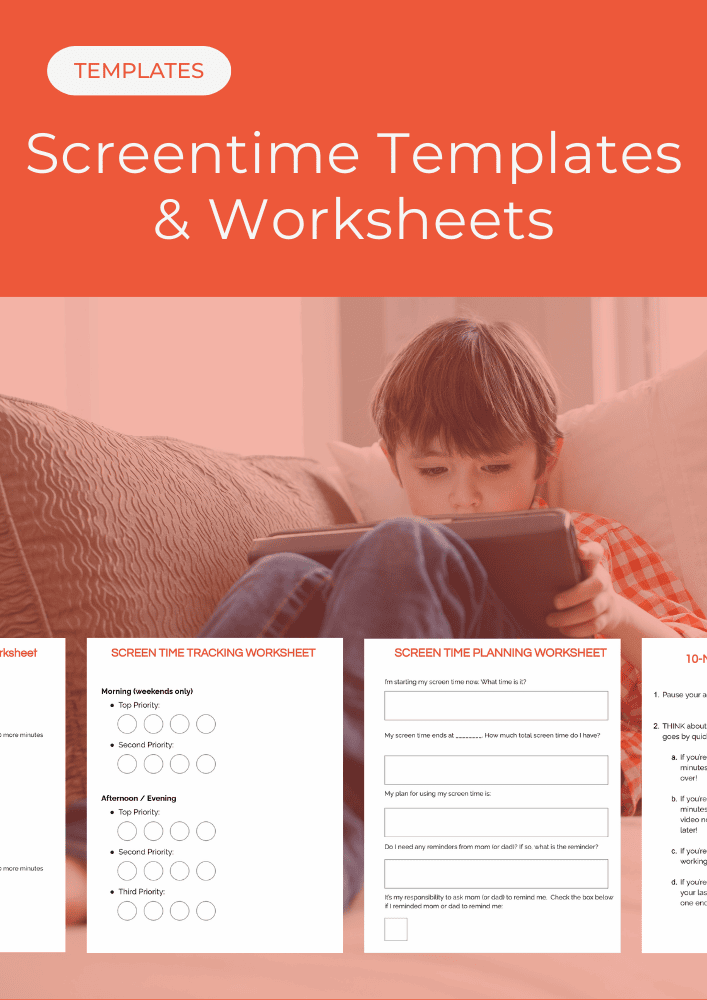
To download a PDF of Asher’s New and Improved Screen Time Planning Worksheet, enter your email below. You’ll also get full (free) access to the Tilt Resource Vault, with all of Debbie’s downloadable resources.
Episode Transcript
Debbie:
Today, we’re devoting our whole conversation to a subject near and dear to pretty much every family’s life these days. Screen time, like most of you listening, we have been trying to figure out how to best balance, manage and negotiate Asher’s engagement with all things screens so that it doesn’t negatively impact our family and so that it doesn’t take over his life. And before we get started, to be clear, we’re not here to say that our way is the right way, or that we have all the answers when it comes to exactly how much screen time is the right amount, but because the issue of screen time has been a source of significant stress and discussion in our family over the years, and I know I’m not alone here, we thought it might be useful to share some of our strategies for making Asher’s relationship with the computer and iPad more workable For our family.
Maybe a month or so ago, Asher, we were using a new screen time planning worksheet, yep. And as new back then, it was new back then. And as we explained on a previous podcast, we were using the bubble system, which I’m kind of borrowing from the Pomodoro method, which is in this productivity planner that I use, but not to advertise for them, or any but not to advertise for them. However, I noticed that the screen time planning worksheet was starting to be less effective. Do you remember why that was the case?
Asher:
That was because I saw I got bored. I didn’t I didn’t really reflect them on what I was going to do with my time. Sometimes that works. Like, for example, I was playing a game called Kerbal Space Program, and I was in the middle of sending something to the moon, and then my timer went off and and I immediately did everything to get ready as fast as I could and quickly reset the timer and jump back on to make sure I hadn’t missed my maneuver note.
Debbie:
So just for reference, in a previous episode of this podcast, the one about distraction, Asher and I talked about the screen time planning worksheet he was using at that time, the one we’re talking about here, if you want to see a copy of that visit the show notes for that episode at tilt parenting.com/session12. Our deal was that Asher would set his own timer for a set period of time, and then when the timer went off, he’d fill in a bubble and determine how he wanted to spend his next chunk of time if he had any time left, and then set a new timer. The goal was both to keep him focused on what he wanted to achieve during his screen time, so he wouldn’t get upset if he squandered his time as well as put the onus on him to manage his own time. Okay, back to the conversation.
So I think what was happening was we were both getting lazy. Yeah, and what I noticed starting to happen was that your timer was going off, you were acknowledging it, you were setting another timer, and you were diving right back in. So what was the key piece we’re missing?
Asher:
The key piece was to reflect, like, when I already know what I’m going to do with my next time, then that’s great, but if I don’t right, and I just jump back on, then I’m like, then I just, I, I take a portal to the universe of distraction.
Debbie:
So I brought in a copy of our current screen time planning, because we made with more advanced screen time OC,
Asher:
Yes, with more advanced screen time-ocity.
Debbie:
So we have our screen time planner, and we took the original one and we added some steps at the bottom as a visual reminder for you for what you need to do every time your alarm goes off. So could you walk us through what those things are?
Asher:
Yeah. So first, when my alarm goes off, I take a pause for what I’m doing, okay? And then I do some sort of activity, usually jumping jacks, to get my head out of the world of screen time. It’s so magnificent. And then I fill in a bubble on my sheet. I take 10 deep breaths, then I see if I have enough time left to my sheet to take 30 more minutes, and if I do, I think about how spend that time, and I start a 30 minute long timer.
Debbie:
Okay, so that is like the whole system for what happens in between these 30 minute chunks. Yeah, that’s the important part. We just added this the screen time planner about three weeks ago, and we were doing it because what we realized, and we had a long conversation about this, because things were starting to slip back to a not so great space with screen time in general. And so we had, like, an emergency meeting, right?
Asher:
Yeah. And we were like, hey, these old screen time planners worked. Maybe we could revise them and improve, improvise eight, improvising them, right?
Debbie:
And I think what we are like, I specifically remember a conversation where we realized, this will work, right? I mean, it takes it. I have to form it. Have it which I’m I’m forming, right? But it works, and we’re going to keep using this strategy until it stops working.
Asher:
Because that’s what you do to strategies.
Debbie:
So yes, I would say I agree that it is working for now. Do you feel like you are actually forming like new habits?
Asher:
Yeah, definitely.
Debbie:
Because you know what Asher one of our big initiatives, or our big things that we’ve been working on this year is you being responsible for tracking your own time, because it used to be all on me or your dad…
Asher:
And then whenever something happened that I didn’t like, I would blame you, right?
Debbie:
So we were constantly, we’re like, the time police, and we were always having to be like, hey, time’s up. Hey, time’s up. So we were that cop, bad cop. We were being the bad cop, and we were bearing the brunt of your dissatisfaction with that turn of events, right? And really, we know that it’s important for you to start managing your own time.
Asher:
Yeah, because then I’m responsible, and then I don’t take out my annoyance on anybody else, right?
Debbie:
That’s what we want.
Asher:
And I’m like, Oh, God, I’m such an idiot. I should have I should have thought about my time. I’ll remember to do that in future.
Debbie:
But let me ask you this, probably two and a half years ago, we bought a special timer that is just for kids who struggle with time and it, I don’t know if you remember this. It’s in your closet somewhere. You do. You really dislike this timer, but it has, it has, like a red zone, a yellow zone. What? It’s intrusive?
Asher:
Yeah, it feels a bit intrusive. Why? And it feels a little bit baby.
Debbie:
Okay, you didn’t like the design.
Asher:
Not at all, and I can’t, I can’t have a dissatisfactory timer. Can I?
Debbie:
Well, you know what else I think is another point that’s specific to you, and maybe other kids feel the same way, but you don’t like it to be visible.
Asher:
Yeah, because that makes me really ridiculously stressed. I’m like, Oh crap, am I going to be able to finish this in this much time? Because I was planning to spend the next time on this, and then I spend the whole thing stressing out instead of actually doing what I meant to do. And I’m like, Ah, it all happened like I thought it would. I have to take extra time into this so I can finish this, and it just completely throws me off.
Debbie:
So you get really anxious about
Asher:
Yes, because I’m like, Oh crap, I have to, I have to finish launching this rocket so I can watch this video that was really funny.
Debbie:
And you are someone who likes to have the when the alarm goes off, it hits you as a surprise, but…
Asher:
That’s better than looking at it and seeing, Oh, crap, I only have four minutes left. Ridiculously stress.
Debbie:
Okay, all right, that’s good to know. Ridiculously stress is not really the best of feelings, no. So that’s why the visual timer didn’t work for you. That makes perfect sense, especially not when you’re using a limited commodity, right, otherwise known as screen time. Yeah, okay, all right, so do you see? Do you feel like this is getting easier?
Asher:
Definitely.
Debbie:
Okay. It’s awesome. I would concur. I would say that, do you forget occasionally?
Asher:
Like once, I was doing something with an alarm, today, I was doing something with alarms, and my timer went off and I didn’t hear it, because I was like, previewing alarm sounds for something that needed alarming. And I was like, No, I don’t like that sound. It sounds like there are two alarms sounds going off at once. I’ll listen to this one, and then by the time I listen to the next one, then my first alarm had stopped. And then I was like, and then later I looked at and I was like, and then I crossed off 45 minutes.
Debbie:
Yeah, you took responsibility for that time, which I think it’s great.
Asher:
Yeah, it’s not like. It didn’t get time, so it doesn’t count. Okay? I’ll just fill in a half hour and be released.
Debbie:
You’re being very responsible with your time. I have noticed a big difference, and I would say, I think this is working. You have asked me when we had our emergency meeting, you asked me to help you, to help support you in remembering to do these steps, like taking 10 deep breaths and taking a pause and all that. And so what I’ve been doing sometimes is setting my timer at the same time, and then I just kind of…
Asher:
Oh, you’re so smart.
Debbie:
Well, you know, I have my tricks, but that way, even if I’m working in another room or doing something else, I am aware of what’s happening, and if a few minutes past that time or go off, I can just poke my head and say, Hey, what’s going on? So I feel comfortable doing that, because that’s not me pestering you, but that’s me kind of being your backup. Because, yeah, I feel like, if you can really form this new habit, it’s gonna just get easier and easier, right, right?
Asher:
But now my face hurts. Why? Because of all the dramaticness. Dramatic cause the dramaticness.
Debbie:
Okay, so moving on. Before I think we’ll probably do more of these conversations about screen time. And actually, we have another one we’re going to talk about on another episode, because this is, like, probably the number one struggle that most families with kids, whether they’re differently wired, or whether they’re as neurotypical as can be, screen time is a huge challenge, so I’m hopeful that these strategies are helpful for other people. Do you have anything that you want to add before we say goodbye?
Asher:
Can you keep the part with the dramaticity in the podcast?
Debbie:
Okay.
Do you have an idea for an upcoming episode? Please share your idea in my Suggestion Box.