Dr. Susan Baum on 2e Learners & Elmbridge University’s Program on Cognitive Diversity
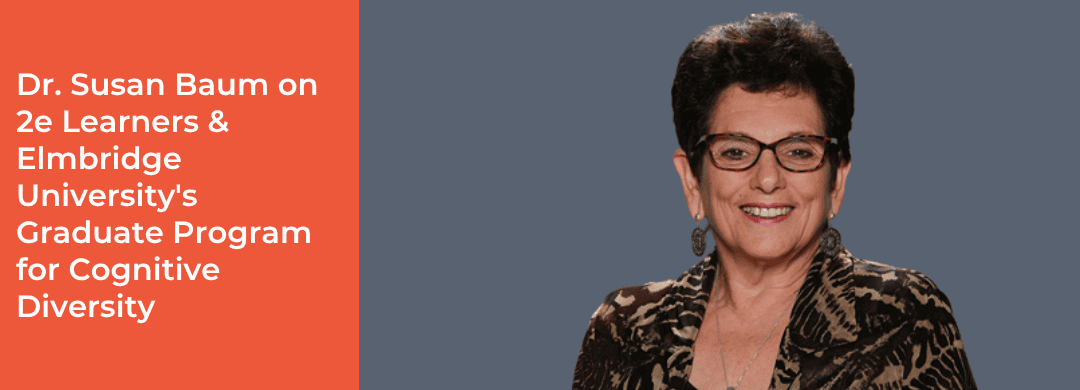
This is a short, special mini-episode I’m sharing because my friends at Elmbridge University (formerly Bridges Academy) let me know that enrollment is now open for the next cohort of their truly unique graduate program in cognitive diversity in education, and application deadlines are coming up in June.
When Dr. Susan Baum—one of the leading voices in twice-exceptionality and Chancellor of the program—said she could join me for a quick conversation about her work and what makes this program so impactful, I said absolutely. In this brief chat, Susan shares insights into supporting twice-exceptional learners, why environment matters so much, and how this program is helping educators better understand and serve complex, neurodivergent students. If you want to learn more, you can head to https://elmbridge.edu/.
About Dr. Susan Baum
 Susan Baum, Ph.D., is Chancellor of Elmbridge University’s Graduate School for Cognitive Diversity in Education (formerly Bridges) and Co-director of the 2e Center for Research and Professional Development at Bridges Academy, a school for twice exceptional students. The author of many publications concerning the needs of special populations of gifted students including the award-winning 3rd edition of her seminal work To Be Gifted and Learning Disabled, Susan is a popular international speaker whose message is celebrating neurodiversity. She served on the Board of Directors of the National Association for Gifted Children and is past president and co-founder of the Association for the Education of Gifted Underachieving Students. She is recipient of the Weinfeld Group’s Lifetime Achievement Award for her work in educating the twice-exceptional child.
Things you’ll learn from this episode
- The rise in awareness and identification of twice exceptional individuals, including advocacy and policy changes in schools
- Common misconceptions in education about giftedness and disabilities, and Baum’s theory of green — the paradoxical profile of these students
- The importance of tailored environmental components — intellectual, social, emotional, physical, and creative — for thriving twice exceptional students
- The evolution and impact of the Bridges Graduate School of Cognitive Diversity (now Elmbridge University)
Resources mentioned
Want to go deeper?

The Differently Wired Club is not your typical membership community.
There’s something here for everyone, whether you’re a sit back and absorb learner, a hands-on, connect and engage learner, and everything in between. Join the Differently Wired Club and get unstuck, ditch the overwhelm, and find confidence, connection, and JOY in parenting your differently wired child.
Learn more about the Differently Wired Club
Episode Transcript
Debbie:
Hey Susan, welcome to the podcast.
Susan Baum:
Well, I’m thrilled to be here. Thank you for inviting me.
Debbie:
Well, of course. I was really excited when I got a note saying you were available to do a short little conversation. And we will bring you back onto the show for a deeper look at twice exceptionality and your work in this field. But we’re this is a special little mini episode that we are doing because I want to bring attention to the program that you’re involved in, the graduate school program. But before we do that, since I have you, I wanted to ask you about twice exceptionality. I’m doing a lot of reflection at the moment. Tilt just had his 10-year anniversary and I’ve been really thinking about what has changed since I started Tilt in terms of awareness and understanding. And so I’m gonna pose that question to you. Where have you seen a lot of growth in the field that you’ve been an originator of?
Susan Baum:
Well, certainly awareness has grown greatly. And a lot of adults are coming forward and saying, I am twice exceptional. I know that growing up I had a differently wired brain. Some are identifying with autism, some more with ADHD, some said I always had dyslexia. And now people are willing to own it and because I think they’re feeling that they better understand their journey. So and we know that more kids are being diagnosed perhaps as twice exceptional, not served well, but at least there is more advocacy for them and again greater awareness in schools because some jobs are opening up, which is amazing to me. The city of Denver is looking for a coordinator for twice exceptional. Amazing. There’s a school in Washington, DC that’s looking for a headmaster in the school for twice exceptional. Another district in Maryland has a coordinator for twice exceptional. This is amazing growth. So I’m very excited about those things.
Debbie:
Yeah, that is Yeah, that is incredible momentum to see. And where would you say then some of the kind of biggest misunderstandings are still in schools? Like do you, you know, because I think there’s this idea still among some teachers that you actually can’t be gifted and have a learning disability. Are there some kind of common themes that you’re still continuing to come up against?
Susan Baum:
I too am reflecting. I’m actually writing a memoir, thinking about how my ideas developed over the years and where they started and what has changed them over time. And so I’m doing a lot of reflecting with a colleague who she and I entered the field around the same time. And sadly, certain problems still exist, but one that’s come to mind lately because I’m working on what I’m calling Baum’s theory of green. And that has been what I’ve been working on over time because as you may have heard me talk about before, I think about these kids as having extraordinary strengths in certain areas that conveniently to me that’s the color yellow. But they have challenges. Sometimes the challenge is from their gift area. It’s not always saying you have a challenge because you’re ADHD, that comes with strengths and challenges, and we call that blue. But truthfully, they’re never yellow or simply blue. They are always green. Because they have both of these extraordinary challenges and extraordinary strengths at the same time. Now, depending on the environment, it’ll either be blue-green or yellow-green. But it’s never just yellow. And it’s never just blue. And that’s where we make our greatest mistake because we don’t understand that profile. What happens when these two different traits, seemingly paradoxical traits, collide? And because of that, we see a lot of behaviors in these kids in terms of emotional regulation and behavior that looks oppositionally defiant, or their needs. Remedial needs are being met, but the gifted needs are not. They’re really misunderstood. And what I am finding is schools are looking for compliance, not engagement. And this is haunting me because when you see a twice exceptional youngster dysregulated or acting out or refusing to do work, they deal with that behavior and they don’t ask why. Are we seeing that behavior? And it’s because of green. It’s because we’re not really understanding what green needs to thrive.
Debbie:
Yeah. Yeah. And then you layer into that the sensitivities of gifted kids, the perfectionism, the p perhaps, you know, perceived criticism or having rejection sensitivities and then getting that feedback.
Susan Baum:
And really the expectations for them are not always appropriate. Their own expectations make them fail themselves in terms of that perfectionism that you’re talking about. And they don’t. They live in a world of paradoxes. You know, why am I so smart? No one gets it, and yet I can’t even do the simple things that other kids who aren’t as smart as I am can do. And it’s really a hard life for them to navigate.
Debbie:
Yeah. Yeah. That asynchrony. We just in my community, my differently wired club, we spent the whole month talking about living with asynchrony and we talked about it from the parents’ perspective, how perplexing it can be to raise these kids who have such asynchronous development, but then also spending time thinking about the internal experience of a twice exceptional student.
Susan Baum:
Yes, exactly. and we find that and and a lot of our work especially at the graduate programs that we have is centered around the idea of the appropriate environment for these children. We started this work at Bridges Academy, the TUE Center, many years ago when we with one of our symposiums, you know what is an environment in which these kids can thrive. And we really decided there are five different components of that environment. One’s the intellectual environment, and one’s the social environment, and the physical environment, of course, the emotional environment, and even the creative environment. And if they’re not in alignment and we don’t see a fit, over time it’s causing. We just did a study. One of my doctoral students just finished her dissertation. It drove parents to homeschooling. And in homeschooling, not knowing the these five environments for growth, what they did for these children really aligned those environments to meet that child’s need. And different ones of those environments are more important at certain times. Sometimes when the children went to home school, the social environment didn’t work. And then the parent had to make a decision. Do I want to find an environment where the social life will be better for this child, or do I want to keep him safe and keep him home because the emotional environment’s better? And so, you know, it at least gives us a vocabulary to discuss these kinds of dilemmas. Yeah.
Debbie:
Yeah. Yes. That was I mean, as someone who homeschooled my two we kiddo for six years, those were the conversations we were always having, and it always felt like compromises were always having to be made.
Susan Baum:
I know and what bothers me and it goes back to that question you asked about compliance versus engagement because if the emotional environment is really problematic, they’re not no school will say, are we intellectually stimulating this child? They don’t go there and I think one of the reasons is they don’t really get gifted or they don’t really like the gifted label and they feel they’re ill-equipped, and maybe they are. to deal with very, very bright children. But it’s becoming a really big problem in my eyes that never will they say this child needs to be more engaged in what they’re learning. Their brain can’t focus, I don’t care how much medication you give a child, they can’t focus on information that’s not novel. The brain can’t do it. And you know, and I get into this thing about circle time, you know, these little kids having to sit in circle time. It’s really sort of like they just can’t, you know, and and and they don’t understand how are they paying attention, learning the days of the week when they’ve known them since they were six months old? And then they’re supposed to sit still and maybe they have the wiggles anyway from an ADHD type wiring. And then the child ends up in time out somewhere because they can’t sit still on a rug. And it’s a metaphor for the dilemma these poor kids face with this asynchrony. Yeah.
Debbie:
Yeah. We’re gonna pivot in a second, but I just have to say it was like it was not doing okay at circle time in preschool, which was like our first indication, like, okay, this is not the right school. My child was kind of secluded for not being able to sit crisscross applesauce at the age of two. And I was like, my gosh, not the right place for us, but…
Susan Baum:
I know. But that’s but that really is like a metaphor, that is really symbolic of other issues that come along where we’re again about compliance, these are the school’s policies. We just need the child will be better off if they learn how to fit in. And I think with the neurodiversity movement, that has changed a lot in many settings. I mean they realize that maybe it’s a social model, maybe the environment has more to do with it than this idea of this child, something’s wrong with the child and they don’t say, well, what is wrong with the environment?
Debbie:
Okay. so obviously we could talk about this for hours and and I would again like to bring it back to talk about this, but I do want to talk with you about the graduate program. You know, I know it, it’s now Elmbridge University. It used to be Bridges Graduate School for Cognitive Diversity.
Susan Baum:
Yes, and so Bridges Graduate School grew out of the success Bridges Academy had had over the years with this profile. And we were encouraged or I was asked to help start this graduate school. I really was against it initially. I think who starts a college? I mean, you just go and start a preschool, but you don’t start a college. And you know, then I was convinced that we’re gonna go in that direction, so we might as well have a graduate school. And it’s been absolutely life-changing for me. And the wonderful interest we have and the students who some of whom are too e twice exceptional themselves or have children who are twice exceptional but are all dedicated to helping change The situation for these kids in the real world, being at home, school, or the workplace. And the program evolved in three specific programs. We have a certificate. Interestingly, a certificate program might be for someone who’s already a psychologist, but really doesn’t feel comfortable with the twice-exceptional diagnosis. So they really want to become more aware of that profile. And we get therapists. Come in for that reason, even some medical doctors. We’ve had pediatricians, we’ve had osteopaths and chiropractors because they’re seeing more and more of these children in their practice. So we have this certificate program. We have a master’s degree program and a doctorate. And many people who start and either the certificate if they don’t have a terminal degree or the master’s program stay because they get so they found their peeps and they’re feeling so supportive that they stay and they get their doctorate. It’s been an amazing journey and basically we try to promote a a deeper understanding of this profile through the lens of strength-based talent focused learning. And that doesn’t mean we ignore deficits. It means there are ways that people can improve in challenge areas, but it makes more sense to try to develop those skills if you align it to their brain wiring. And if you try to, you know, force them to learn it in a way that is not natural to how their brain learns, it’s just not a very pleasant journey and often not successful.
Debbie:
Yeah. Yeah. And, you know, I’ve known a number of people who’ve gone through the program over the years. And some of them, you know, I know folks in the Tilde first have contributed to their research for their dissertations they’ve been working on or participated in pilot programs. And I’m just curious, you know, one of the reasons that we’re having this conversation is because enrollment is open. And I know just based on people I’ve known who have gone through the program that it tends to draw from Well, I’m curious to know from you, but I know there are a lot of parents I think who wanna better understand who their kids are.
Susan Baum:
I know. So when I was on Bright & Quirky, those days that I worked with that, Debbie Steinberg Kunz, they would hear me and so some people got intrigued to maybe that’s a good thing for me to be doing. You know, there’s a place where I really could learn and make a difference. And as and I I really believe that most of our students If they’re not 2e themselves, do have children who are 2e. So even though we do have some teachers and heads of school and you know more predictable students, we have this enormous percentage of students in the programs who have kids, who are going through this journey. So you’re absolutely right. And it’s a great place for them not only to learn and more deeply understand their own child, they become better advocates, but they find a community and they go through this program with each other, and they’re friends forever. They start interesting initiatives together, and it’s just wonderful. Even though it’s an online program, it seems more like a brick and mortar program because they become a cohort and they really build relationships, not only with their peers, but with the faculty as well.
Debbie:
Yeah. Yeah. That’s great. And you know, and we’ll wrap up in a minute. But one of the reasons why again I wanted to bring you on to talk about this is because I know that so many folks that I meet, and I’m one of these people, like I do what I do because of who my child is. And so many people I know listening are inspired through their journey to create something to help their kid, to support their families or other families like theirs. And so I’m guessing there are listeners out there who have been kind of considering this program and so enrollment is open now and that’s why I wanted to bring you on the show. Is there anything that you would want them to know to think about or in terms of how to know if this is a program they should be considering?
Susan Baum:
Yeah, I think we have one of the best admissions directors who loves to hear the stories of parents. Since she has a 2E child herself, she also went to the program and Kim Vargas is her name and she’ll talk to you forever. And together you can decide maybe this is a good journey for you. But she lets you cry like you cry together with her, you share stories and she’s the most wonderful person to To actually talk to a real person who understands what you’re going through. And it’s worth a conversation, if nothing else. And the best way to reach her is to go to Elmbridged.edu to that website, and it will show you how to contact the admissions director.
Debbie:
Okay, that’s perfect. Aw, Kim, I got to hang out with her. I got to hang out with Kim years ago. Yeah, when I was part of the symposium and I and I do have a special place in my heart for her. So listeners, we’re gonna wrap up. This is again a short and sweet little chat with Susan and I will bring her back on for a longer conversation about twice exceptionality. But if you’re interested, I will make a little show notes page for this where you can find a link if you wanna explore this. If this has been like a voice in the back of your head, like this is something I might want to look into. Now is the time to do that. any last thoughts before we say goodbye, Susan?
Susan Baum:
Well, to the audience, there’s hope. Focus on what your child can do. I promise you, I’ve been in this field a very long time. And so when people come back and say, the best advice you ever gave me is to start paying attention to my child’s gifts, you know, it really did pay off in the long run. So there’s always hope.
Debbie:
Great message. Great message to end this on. Thank you so much. It was really nice to hang out with you today.
Susan Baum:
Nice talking to you. Hope to see you again soon. All right, thanks.
Do you have an idea for an upcoming episode? Please share your idea in my Suggestion Box.