
Therapist Jude Carn on Internal Family Systems (IFS) and Neurodivergence
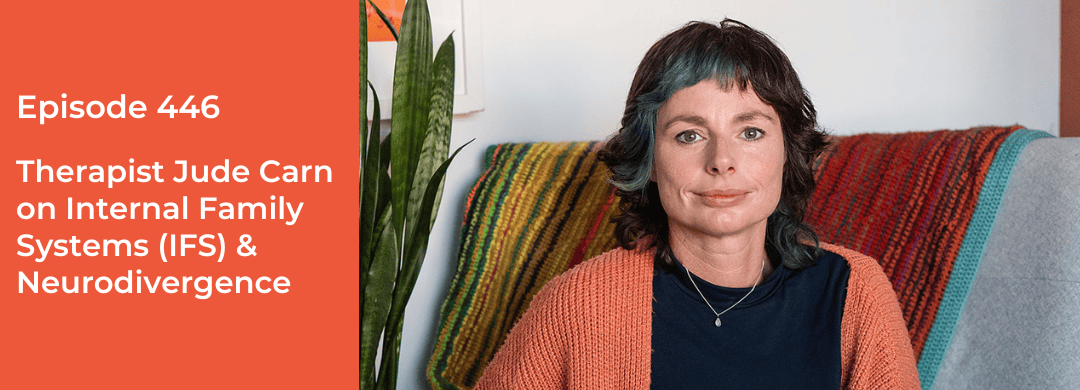
IFS, or Internal Family Systems, is a powerful and compassionate therapeutic framework for understanding the different “parts” within ourselves—like the inner critic, the protector, the people-pleaser. Through IFS, we can learn how to befriend and heal those parts so we can show up more fully as our true Self. I’m pretty fascinated by IFS and have seen how transformative it can be in helping people truly heal and find more peace in their lives. In my research, I came across a therapist who not only feels the same but has fully stepped into the intersection of IFS and neurodivergence.
In today’s episode, you’ll meet Jude Carn, a certified Level 3 Internal Family Systems (IFS) psychotherapist, international consultant, and passionate advocate for neurodiversity. Jude walks us through the core concepts of IFS, explains how this framework can be especially healing for neurodivergent people, who often grow up feeling misunderstood, judged, or exiled, and shares insights on how IFS offers a respectful, empowering approach to trauma that allows each person to move at their own pace. Jude explains that recognizing and befriending one’s own parts can lead to deeper self-acceptance and a better relationship with ourselves.
About Jude Carn
 Jude Carn is a level 3 certified IFS psychotherapist and approved consultant with the IFS Institute. Jude lives in the UK and works online internationally with some clients and mainly in supporting other therapists through supervision and consultation. Jude is a late diagnosed AuDHDer and an advocate for the recognition of neurodiversity as part of the human experience, rather than disorder.Jude creates and runs training, conference talks and groups supporting therapists to provide better support and care to their neurodivergent clients. She is genderqueer, and uses she/they pronouns. She co-hosts a podcast, Queering IFS which sets out other questions taken for granted norms around heteronormativity and neuronormativity as these present themselves in the world of therapy. Jude lives at home in rural Sussex with her two dogs and long term partner.
Things you’ll learn from this episode
- What IFS (Internal Family Systems) is and how it helps individuals foster deep self-acceptance through exploring inner parts
- Why every coping strategy has a purpose, often driven by protectors working to shield exiled parts that carry pain
- How recognizing and building relationships with internal parts can lead to profound healing and growth
- How IFS allows respectful trauma exploration at one’s own pace
- Why neurodivergent individuals may especially benefit from IFS’s flexible, creative, and affirming approach
- Ideas for how parents and therapists can help their children understand and connect with their parts
Resources mentioned
- No Bad Parts: Healing Trauma & Restoring Wholeness with the Internal Family Systems Model by Richard Schwart, PhD
- Dr. Megan Anna Neff and Dr. Debra Brause on the Complex Relationship Between Traditional Therapeutic Modalities and Neurodivergence (Tilt Parenting Podcast)
- IFS Institute Online Bookstore (including books for kids)
Want to go deeper?

The Differently Wired Club is not your typical membership community.
There’s something here for everyone, whether you’re a sit back and absorb learner, a hands-on, connect and engage learner, and everything in between. Join the Differently Wired Club and get unstuck, ditch the overwhelm, and find confidence, connection, and JOY in parenting your differently wired child.
Learn more about the Differently Wired Club
Episode Transcript
Debbie:
Hey Jude, welcome to the podcast.
Jude Carn:
Hey, thank you for having me.
Debbie:
Well, thank you for accepting my offer. You got emailed by a stranger. And I’m like, will you please come on my show? But I’ve been wanting to have a conversation about IFS or internal family systems for a while. I refer to it sometimes in conversation, but I am not an expert in it. And I just think there’s a lot that we can discuss today that would be really interesting to my listeners. So would you mind, you know, I’ve read your formal bio, but would you mind just telling us about yourself and the work that you do in the world? And I always like to ask people about their personal why as part of that.
Jude Carn:
Okay, cool. Yes. Yeah. Well, if I miss any bits of it, you can ask me again, because I’m good at forgetting the second half of a question. So I’m a certified IFS psychotherapist, and I predominantly work with, well, if not exclusively, work with neurodivergent clients and therapists. So I also do a lot of consultation and supervision depending on what country you’re in, it’s called different things with other neurodivergent therapists one-to-one and in groups supporting them to do their work. And then yeah, I do some client work as well. I’ve been a therapist, good 15 years now and came to IFS just at the beginning of COVID, so five years ago. And I, yeah, hook, line and sinker, all in. And yes, I mean, we’re going to talk a lot about IFS, I imagine. So yeah, that’s sort of a start. I live in the UK. I live with my long term partner and our two dogs. And yeah, as I look out my window right now, we moved about two or three months ago, out of the city into the countryside and it’s just so good for my system. I live here and I look out the window and I see a tree and it makes me very happy.
And I guess, mean, in the other thing I forgot to say is I’m late diagnosed ADHD autistic as well. So I’ve known that for about, again, about five years. And I would say really, you know, what brought me to this work was probably just the experience of living in the world as an undiagnosed already HDS. And, you know, I always had a lot of empathy, strong feelings and really struggled to make sense of the world, but was fascinated by people, why they do what they do and what they do and love deep conversation. And I think there was a point in my mid 20s when I was like, I don’t really know what I want to do. But I know that doing this nine to five office work or whatever it was I was doing at the time was like crushing my soul. Again, undiagnosed. And I just thought, I’m, you know, I’ve, I’ve, this is something I’m kind of interested in. And so I just started training as a therapist from there. So that’s my personal why. then, I mean, it’s the only job I’ve ever had that I haven’t got bored of. yeah. Yeah. Right. Yeah. And I work for myself. So I get to choose what I do, which is, is big.
Debbie:
That’s very relatable. I finally had to create a job that would capture where I could do whatever I wanted. Well, let’s take a step back before we kind of, because I tend to jump in really deep and I forget that I haven’t kind of laid the foundation for my listeners. So let’s just talk about IFS kind of in broad strokes and kind of give an overview of what it is. Okay.
Jude Carn:
And I think the place to start with that is IFS comes from a perspective that you are not broken. That fundamentally we all have the capacity to heal ourselves. And the way that IFS lays that out is that we have within all of us, we have a system of parts, parts of us that might be in protective roles, parts of many parts that might be in protective roles and also parts of us that might be burdened by experiences or things from the past who are often very young, not to say protectors aren’t often very young too, they just might sound like our inner critic often sounds quite old to us and quite authoritative, but really that’s just a kid in a business suit a lot of the time. And so this is something I’m not sure exactly what my perspective is at the moment. and we all have this, within all of us, we have self energy. And that is the energy, which is not a part. And that is a place from which we can meet our parts. And we can hear them and we can heal them. And we can help let go of those burdens. Now, sometimes self is kind of conceived as this like, you know, this like, all knowing or seeing kind of center of us, which can sound quite spiritual. I’m sure we’ll get into this more soon as well. But, you know, that doesn’t look the same in every single system. But I really, what I find really helpful and what I’m finding more helpful with my clients as we go forward is this, this idea that we all have this self energy within us. And that this, the more access we have to this energy, both the more access we have and the more we can meet our parts from this place, the more capacity there is for healing and also choice. Like, we always do a thing a certain way, or we always fear a certain thing. But if we can get to know that part and know why they, why that’s so important to that part of us, or what they’re afraid of, then we might be able to have a choice.
Debbie:
And I’m thinking about how I first heard of IFS. And I think it was my sister who introduced me to it years ago =. This was a modality that for my sister just kind of connected so many dots. And it just changed her life and so she started sharing it with me. Then I started working with a therapist who would weave it into the work that we do together. But there’s something about it that felt so different from other types of therapy that a lot of us are, cognitive behavioral therapy, some of these other things. So what is it about this approach that, I guess for you even, like what was it that said, I’m all in? Because you just said,you discovered it around the time of COVID, around the same time you discovered your own neurodivergence.
Jude Carn:
Yeah, great question. So what is different? I mean, everything, but the thing for me that first really, really attracted me to IFS was just this sense of you’re not broken. So for example, if you’re working with someone who’s self harming, you can recognize there is a part of you that is doing this and it is a solution to a problem. Can we get to know that part and understand why they’re doing it? So you’re saying to that person, yeah, you have a part that has an answer. And maybe sometimes that works and maybe sometimes it doesn’t. And maybe you’d like to do something different. Let’s get to know that because that part is trying, their intention is to help you. And just having this capacity to talk to people about people and about myself with the language of parts is so de-stigmatizing. Like I have anxious parts. I have controlling parts and you know I’m talking about kind of maybe the features of these parts rather than their whole essence too and that’s a whole other rabbit hole which we probably don’t have time to talk about in an hour but it just you know it’s like it just takes that weight off it’s like yeah I have parts that do this yeah I have a part that numbs out by scrolling on my phone or eating chocolate yeah I have a part that spends money they I shouldn’t just because it’s fun to get dopamine hit or even to be a bit sneaky about it or whatever but it’s like that’s a facet of me it’s not all of me though so you know it like gives you that capacity to go yeah I have parts that
Debbie:
Yeah, it’s not judgmental, right? It does feel kind of freeing. It’s like, yeah, it’s almost otherizing. I think about thought work that people might do. It’s like, you’re always wanting to separate yourself from the thought, right?
Jude Carn:
Yeah. So if we come back to CBT, which I, you know, I was, I have done some training in before, which I think I’m not, I’ve, okay, so I want to caveat all of this and say, I don’t think any, you know, therapeutic approach, except maybe ABA is, you know, bad. And I think there’s, features of CBT that can be really helpful. Again, it’s maybe about having the right therapist who understands what they’re working with and all of those kinds of things. In CBT terms, we’re focused, yeah, the thought, the thought we need to act, we need to manage the thought. We’re not seeing it as a part. We’re not looking at why. And we’re not sitting down with that part and saying, hey, you’ve been doing this for me for a really long time. And I really appreciate that. And you know what, maybe I love you for it. Do you know that I’m now 42 or whatever? And so it’s like, and then that part can go, I didn’t, I thought you were still 12. And that’s really powerful.
Debbie:
Yeah, and I just want to mention for listeners, and I’ll include and link in the show notes for this, but as Jude is talking about that this is a part of you that is there to help you, that we can have a relationship with it, the book that I’ve been working from is Richard Schwartz’s book, No Bad Parts, right? So it’s literally saying in the title, there are no bad parts. That alone is such a game changer, right?
Jude Carn:
Right? Yeah, absolutely. And I’m talking fast and talking a lot now. So if you need me to slow down, because I’m in my passion, my passion window. So the first therapy training that I did was kind of psychoanalytic, psychodynamic. And it was okay. But it was always this sense of like this pathology bit, you know, like, and the client like you have the treatment resistant clients and I’m doing air quotes for anyone listening or you know, everything’s about the client’s resistance. And it’s like, oh, the client’s just not, they’re not healing because they’re not trying. And it’s it’s, uh, IFS, you look at the part that’s, know, in the way again, air quotes, you look at the parts that might be resisting, you look at those, you work with the protectors first and you get their permission and their consent before you go to the to the trauma, to the pain, to the more vulnerable places. And I just think that’s such a respectful way to work with the system. it’s also, sometimes people struggle with that no bad parts thing if they’ve got, you know, parts that are causing harm to themselves or other people. And just to say to that, you know, we can recognize, we can appreciate the intent without loving the action. You know, if you have a part that’s drinking loads or gambling or hurting other people, you know, of course, we’re not saying you have to embrace like the damage that they’re causing, but you can still recognize this is a you know, this is a response. This is a safety. If I can get to know this part and understand what they’re doing, then we’re back to that choice word.
Debbie:
I want to ask one more quick follow-up question. I’m wondering if I’d love to know your thoughts on this idea of maladaptive coping strategies, because I’ve had conversations with people who’ve said, actually, they’re rejecting that idea that they’re maladaptive. They are indeed coping strategies, just as you described. you, yeah, I want to know your thoughts on that.
Jude Carn:
Yeah, totally. Like every strategy is there for a reason. It might be that that reason applied when you were six and you’re still doing it at 50, right? Sure, so that in that way, it might be maladaptive, as in it doesn’t really work for your life now, but that is a little, little young protector in your system that’s going, that might even know that what they’re doing isn’t working. Probably they do. But they don’t know how to do anything else. this maladaptive pathology kind of language, right? You’re just shaming a system that doesn’t know what else to do. Yeah.
Debbie:
Okay, so you’ve mentioned the word protectors a couple times. I know that exiles is another, you know, common part that we see. Could you talk about some of these bigger concepts just so we get more familiar with them?
Jude Carn:
Yeah, okay. Yeah, I’ll give it a go. So in IFS, and I think it’s important to say when even describing this, that this is just a generalization that we tend to have parts that are protectors and then parts that are exiles and protectors, you can broadly separate out into managers and firefighters. Now, That doesn’t an internal system is not fixed. It’s dynamic parts change depending on what’s going on and what they need to do. So everything I’m saying is like very general. But yeah, managers are exactly what it sounds like. They’re the ones that manage the system. So they are proactive. They they have a motto. Actually, all protectors have this never again motto. So say I have a childhood experience, have plenty of these, of being too much or not enough. My inner critic is a manager and they’re like, right, never again, never again are we going to get externally shamed like that. And I’m going to make sure by making sure you get it all right. And that might sound to me like, yeah, like an inner critic telling me, you’re being weird or you’re talking too much or you’re not talking enough, but that part’s trying to protect me from an external shaming experience. Yeah, so we tend to have a lot of managers around, literally managing. You can imagine them in their suits kind of trying to run the show. And then we have firefighters. And again, they are what they sound like. So, you know, when a house is on fire, firefighters, they go in, they break your door down.
They might soak all your furniture in the process, but they put the fire out. So these are parts that are not so what their heroes, they really are. They’re not so worried about, you know, well, what harm might I do on the way they are just putting that fire out. That might look like an extreme version. So that might look like addictions, compulsions, that kind of thing, you know, they’re putting the fire out without having a lot of thought for the cons. What’s the word consequences of that? So they’re taking you away from psychological distress and it’s effective, but it might trash your furniture in the process.
Debbie:
Right, right. Okay, so I want to kind of connect this then to neurodivergent people. So I’m wondering, you why, you know, you’re working in that intersection, and I’m wondering, what is it that you have found specifically about IFS that is so powerful, or why it can be such a useful tool for neurodivergent people?
Jude Carn:
Yeah. And I guess, and I might lose track of these thoughts. So one, the first thing I’m going to talk about is how therapy is not built for neurodivergent folk. And then the second one, I think it’s about IFS specifically. I’ll just say them both and then maybe I’ll hold onto them both or maybe you will, we’ll see. So traditional therapy models. And this is true of IFS too, you know, they all come out of maybe a very neurotypical medical model kind of place. And they have so many expectations on how a client should be and what therapy should look like to be effective. So, you know, the idea that we sit with each other and we talk and we maintain this eye contact and all of, you know, I’m sure you’ve talked about this on other podcasts as well before. But there’s the general ways in which therapy is, is not that accessible or not that, set up for neurodivergent folk. even that thing I was saying earlier about like the treatment resistant, you know, it’s like, not a lot of models give you the capacity to recognize, maybe that’s just, you know, a client who, needs to do, you know, needs to stim to feel, comfortable in this situation or, you know, doesn’t want to, eye contact is painful. So why am I trying to force this? So there’s that side to it, which I guess actually you could include IFS in that too, because I think it’s important to say that I love IFS and I think it’s fantastic, but it can still not be great for neurodivergent folk if the therapist is not at least affirming and informed if not neurodivergent themselves. So it’s not magic. But why do I think it works?
Well, I think it works because we are talking with our clients about the parts of them and we are recognizing that there are defenses there and we’re talking to those parts and recognizing the reasons that they might be doing what they’re doing. And I think we can talk to parts that mask and get to know them. And in a way, I’ve said this before and I’m sort of pausing as I’m saying it now, because I don’t know if I’ve changed my position on this slightly in terms of the wording, but IFS does give us the capacity to unmask because we get to talk about these different parts of us and why they do what they do. Yeah, I do think that. I still do think that. Yeah. Yeah. And I think it also worked. IFS gives us the capacity or good IFS gives us the capacity to be really creative with clients. So maybe we can get to know a nonverbal part through inviting them to write, or maybe we can use things other than words in the room, or maybe, so for some clients, you know, the process of IFS is often this kind of go inside, close your eyes and find a part. And that might not work for everyone. So maybe you can draw parts, or maybe we can just talk about parts if you’re a verbal processor, which I clearly am, and then connect with them that way. So I think it works because it has the scope to be very creative.
And some people see parts, some people just feel them. Some people exist in their mind and they don’t have a lot of body connection depending on, you know, their neuro type, their interoception and lots of other things. So it’s a framework that gives us capacity to work kind of quite differently and quite broadly depending on the person that we’re working with.
Debbie:
Once again, now I’ve got multiple follow up questions. But it’s so fascinating. just to touch, just to go back on you just mentioned masking, I’m thinking about. I’m imagining that within neurodivergent clients, are some kind of common experiences that you see. Masking or camouflaging would be one of them. Could you give us an example or two of something, whether it’s an early childhood experience or something that you see in a lot of clients that IFS can be really powerful in helping to work through or reconcile with?
Jude Carn:
Yeah, well, I think one thing that IFS can be really helpful to work through and reconcile with is helping these little managers and I’m calling them little because they you know, they started off, they started doing this job when we were kids. So they’ve been doing it forever. Getting to know them and updating them on the neurodivergence in the system is huge. Because, these little managers, these never again, these proactive, I just want to stop this system getting any more shame. They are often right. Because ableism is internalized. And, so they are often desperately, desperately trying to get us to just air quotes again for anyone listening, be normal, you know, and they don’t even know that the game is rigged from the start. So that, I mean, it’s almost making me tearful even thinking about it because it’s just so powerful, getting to sit down with one of these managers and say, hey, did you know this? And not that they’re necessarily gonna go brilliant straight away. It might be like, what, this too? But over time, they can just relax and just know, you know, this is a feature of my system rather than something wrong with me. And that’s huge.
Debbie:
Yeah, yeah, it’s profound to be able to make that shift. Even as you said, it’s not like flipping a switch, but to have that new lens accessible and available is incredible. Yeah.
Jude Carn:
Yeah, yeah. Yeah. And that’s, you know, that’s just just, I shouldn’t say just because I think this is actually where a lot of the work is, is, but that’s at the level of the protectors, you know, that’s not even getting down to the little ones, the exiles underneath you are carrying all this too much, not enough, too loud, too quiet, all of those burdens. It’s just the managers, if they can have, you can have a different relationship with them. And that’s definitely reflected in the work that I do with clients, you know, getting those parts to just be able to ease back and give space for people to just be who they really are. Yeah.
Debbie:
So first of all, just love this. I’m visualizing these little managers dressed up in business suits, which I just, I love. And I think about the first couple of times my therapist has kind of brought this up in our sessions and, you know, she would ask me, you know, there’d be, I would say something that was not very kind to myself, right? And then she’d be like, interesting. She’s like, when’s the first time that you felt this way? She would want me to really think, where did that start? When did that part of me first get formed? And I have a terrible memory of a really hard time accessing things. I don’t know why. I’m just not interested in revisiting a lot of that. But it’s been really interesting for me to kind of go through that process and try to identify that. And so I’m wondering, you were mentioning that you might have them go inside and kind of consider and maybe draw or think about or talk about these parts. But can you give us an example or maybe take us a little bit more inside that?
Jude Carn:
Well, I’ll talk about my system because I can consent to that. And so. And I’ll talk about so I’ll give examples of my parts, but I’ll talk about how I would. So exactly like you say, Debbie, so you might catch someone kind of saying something quite negative about themselves or they might come in, maybe they come in and say, you know, this happened and this happened and I’m just such a failure or whatever else. we say, okay, so I’m hearing there’s a part of you that’s saying, you know, this, how well do you know that part? Let’s see if you can connect to it. And that might be the classic IFS kind of close your eyes and go inside or, you know, variations on that. And then you get to know that protector and you might say, okay, yeah, so that sounds like that’s one that’s working really hard to try and stop XYZ happening.
And what are they afraid would happen if they didn’t do that? So you’re getting to know that part and you’re getting to know them, you know, what are they, why do they do what they do? And what are they afraid would happen if they didn’t? And it’s amazing the answers that come up there because sometimes it’s, well, you would die, know, that they, they, they, the stakes for them might be really, really high or your family will reject you or whatever else. Okay. So then you really just validate their fear. That really makes sense. Yeah, if that’s what you’re afraid of, it makes total sense to me that this is what you’re doing. How long have you been doing it for? And that’s when, you know, they might say, I’ve always been doing this, or, you know, I’ve been doing this since Jude was three, or whatever else. It’s like, wow, that’s a really long time. Do you know how old they are now?
So you just stay with them and you get to know them and that process is really powerful on its own. And then, and then If that protector feels like they trust you enough and this might take sessions and sessions and sessions and protectors are really good at sniffing out an agenda. So you have to go at the speed of the system. Then maybe you get down to the exiles, the ones holding the pain that couldn’t be felt in the system or the memory that wasn’t safe or whatever else. And then you work with them to hear their story. Yeah, and that whole process can be fast, but it can also take months, years. That’s neither of those is better or worse. It’s just the speed of a system.
Debbie:
Yeah. And when you talk about the exiles, I’m thinking, you know, we know that so many neurodivergent kids experience trauma just by the very nature of being neurodivergent in the world that the systems they’re engaging with every day. I imagine that you see a lot of that in your clients. And is that exiled? Is that a part of people that it’s too painful, so it’s just banished?
Jude Carn:
Yeah, so parts can get exiled for a number of reasons. It can be that the pain is too much. So the other, you know, the protectors are like, I know, let’s just put it in a box. Cause again, they’re young and they don’t know what else to do. It might be that that was something that was unacceptable to the world. So again, it had to be put away. It might be that we just didn’t know what to do with it and no one around us could help us. And so it just has to be away. So I have an exile who I met recently that is this tiny little mouse bush baby type thing with really big eyes and really big ears and like massive whiskers and it’s about it’s it symbolizes something about sensory overwhelm because it’s like he’s taking all of this stuff in. And being able to work with that when I was able to. I haven’t we’re still still working on it but that was you know just seeing that and seeing this part that was just like it’s all too much and nobody’s doing anything about it. I was able to work with them to hear that story and now they sort of live in this lovely little kind of sensory pod, which is kind of lovely and really super dark blue and really quiet. But yeah, I mean, so for me, my parts are very visual, which is why I talk about them as business suit kind of managers and this little overwhelmed little mouse but people, you know, comparison is a thing. And sometimes if your system isn’t so visual, or you don’t experience parts in the same way, that is still completely valid.
Debbie:
Yeah. I also love the visual of that sensory exile being really supported right now. And that makes me kind of want to know more about what is this? I mean, the question was, what is the goal? But that’s the wrong question. I’m thinking, like, what do we want our relationship to be like, ultimately, with these parts so that we can heal those parts? e in relationship or community with them and whatever that looks like, but so that we can kind of just feel better. I mean, that’s what we’re trying to do here, right? I live lives that feel better.
Jude Carn:
Yeah, yeah, that’s a really good question. And I think actually, yeah, what I want to say that’s really important is that we are never trying to get rid of parts. We can’t and we don’t, we don’t want to, know, even a protector that might be causing harm externally or whatever. The goal is not getting rid of. And I think that’s important to say because it’s both respecting our systems and also sometimes because people’s managers essentially find IFS and think, this is a good way for me to go and get rid of all these guys who keep causing all the problems in the system. And then they end up getting a bit disappointed when you’re like, yeah, not quite how it works. But the goal is like the way I think about it is it’s about for me, so there’s the eight C’s of self energy in IFS, which I will not remember all of now. then see Sykes, who’s one of the lead trainers, bought in this ninth C, I don’t know how long ago, which I think is actually the most, the most important one for me within the eight C’s is curiosity and compassion. And some others, but the ninth one is choice. And I would say, you know, that is a fundamental goal for me is, you know, people having the choice. And that might be the choice to mask or not, because it’s unrealistic to say, you know, as a neurodivergent person, you are ever going to live in a society. Well, I mean, maybe you’re ever going to live in a society where actually all of the time you are going to be able to just unmask and be yourself because that’s just not how the world works. I’m, you know, it breaks my heart that that’s true and it’s true, but having a choice with a masking part, like, I have to go to this social event or work thing or whatever else and I’m going to need to mask when I’m there. Being able to have an internal conversation with yourself about that and say, yep. Okay. So it’s going to be three hours. I can do that. And then we’re going to come home and sit in our PJs and not speak to anyone for however long and do whatever we want. You know, that’s about, it’s about choice. and I’m just trying, jumping back to your question in my head.
What’s the goal? Yeah. So I’d say it’s about that. It’s about, you know, being able to have a better relationship internally to not have. Okay, so I’ve got a very good example that happened two days ago when I came back from holiday and someone, me, booked the return flight to the wrong airport because attention to little details is not my strong point. so we were sitting and thankfully my partner noticed this when we were in the car on the way to the airport when he looked at his boarding pass and was like, Heathrow and I was like no Gatwick. Anyway, it was all fine because we were able to book another flight and blah blah blah. I didn’t have, it wasn’t like an internal pile on in my system because it was my mistake. I completely missed it. Yeah. But I didn’t beat myself up about it. I was like, slip in, that’s a bit stressful. But I was able to, you know, be with myself in that moment and say, yeah, you know, you make mistakes sometimes, can book another flight, yeah it’s going to cost you a couple of hundred pounds and I’m lucky that I can afford to do that and it’s not really a big deal and so but I wasn’t and I didn’t go into like a you know my my fawning part wasn’t there with my partner being like I’m so sorry god I’m such a terrible person you know like make me feel better I was just like whoa that was that was a lucky escape I’m really sorry for the extra stress but looks like it’s all gonna be okay. Thank you for noticing, because I hadn’t, even though I’d already checked us in for the flight. But yeah, so, but I can just be kinder to myself. And that’s a combination of IFS language and knowing about my neurodivergence and it’s both together.
Debbie:
I love that example. And you can just feel how that self acceptance that you know, self compassion, it’s just permission to just not make us our failures or our screw ups or any of those things. Like we’re not enmeshed with all of that. It’s just, yeah.
Jude Carn:
Yes, yeah, exactly. So again, it’s about that space, it’s about that choice, it’s about this is not all I am. nd yeah, I can just go, okay, yeah. And you know, my, my, my managers weren’t piling on like you always do this. You’re a terrible person or whatever else they were like, okay. Yeah. You know, I was straight. I was in the car. I got a bit shaky and a bit, but then I was very, you know, I was able to really quickly just be like, what do we do to fix this?
Debbie:
Okay, so before we wrap up, I know that you work with adult clients, but I did wanna just ask about, for listeners who are kind of noodling on this. And as I said, you know, my introduction to IFS has definitely made me kind of really think about how I might be able to support my child, you know, who is neurodivergent, who can be really incredibly tough on themselves. And so I, you know, I’m not going to impose this stuff on my kid, but I’m wondering if you have thoughts about how we might as parents show up in a way that would help our kids start to get to know these parts of themselves.
Jude Carn:
Yeah. And yeah, it’s a great question. And yeah, I don’t have kids, but I have the right young people I’m very close to in my family who I also don’t know how they’d feel about me talking about them specifically, but yeah, who are also neurodivergent. Parts language, you know, yeah. But, you know, if you say to a little kid, a part of you is really angry and they’re like, no, I am angry then okay yeah you are angry but you recognise maybe I’m talking to a part of this little one who’s really upset and validate them you know and I think this is I think some of this stuff from what I understand is kind of there in gentle parenting already but you know like you can really be with a with a kid and say yeah you really wanted that ice cream I know how much you wanted that without giving them whatever it is, but you’re, you know, you’re recognizing, yeah, yeah, you did really want that. So you’re not denying their experience. There are some really good books, some really good IFS books for kids. I can’t think of any of them off the top of my head. But there’s a really amazing website, somebody who compiles so much of neurodivergent and IFS information, which I can give you after and can check in the show notes.
And there’s cards, which are really good for young people. Well, they’re good for adults and I guess older kids. I was gonna say young adults, older kids. There’s like these cards, I think they’re called inner active and you get a deck of them and they have lots of different pictures of different people doing different things and they can be a really lovely way to kind of go, okay, so yeah, how are you feeling? You know, because like teenagers are not the best with words or maybe they just don’t know and know, Chuck and your divergence in the mix. yeah. And I guess, and again, I’m not a parent. I’m a dog parent. This is relevant there too, but I’m not a human parent, but just recognizing as well, parts of me are getting activated by the parts of my kid. So, you know, I can take a step back here in myself as well as helping them to take a step back and helping them map it out and maybe, you know, getting to know, you know, you could do so many different things like, you know, maybe not in that moment, maybe in that moment, you just need to calm down, take a time out and come back to it later. But later, you could talk about it know, what, what do you, what does this one look like? What does this part of you look like? Should we draw them? Do we want to talk about them? Talk to them? Like, yeah, you can just be so creative with it.
Debbie:
Yeah, I’m thinking of, you know, I just got off the phone with my kiddo who’s finishing up a first year at university running on fumes and trying to encourage them to like go for a walk and get out the door, you know, make plans for tomorrow and how can I support you in kind of doing the things you know? And I was like, your future self will really thank you. And so, you know, I’m just trying to help them see that there are different ways to consider. There’s a part of you that wants to just sit in and get deep in a project and not leave the room. But there’s another part of you that is going to feel so good if you get outside.
Jude Carn:
Yeah. Yeah. Yeah. And it’s like even just that naming of that, creates a bit of that, like a little bit of separation to go, yeah, that’s not all of me. There is a part of me that wants to do this just wants to plow and get everything done. And there’s a part of me that’s exhausted and they need taking care of too. And what can I do about that? Or how can I? Yeah. And as for you and for you, Debbie, as a parent, there’s a part of you that really wants your kid to get outside and stop doing that. And, you know, recognize, you know, so recognizing that, like, you know, you have a part that and they have a part that and that’s where we meet. We meet each other’s parts usually.
Debbie:
Mm-hmm. Mm. So fascinating. I want to just acknowledge too that we have scratched the surface and I’ve, and I, and I really, you know, I asked you, I’m like, come on and tell us all the things about IFS, but this has been such a great introduction. I think you did such a wonderful job of introducing us to the concepts and to talking about and explaining how it could be so supportive, especially for neurodivergent folks, is there anything kind of big picture that we didn’t touch upon that you would want to mention before we wrap up?
Jude Carn:
We touched on it, but I just think it’s important to say IFS is a brilliant, brilliant framework. And I love that, you know, Dick Schwartz, who’s the discoverer of IFS, as he says, not the creator, you know, that these books are so accessible for anyone. And I would just say, if it doesn’t look like that for you, that’s okay. You know, we don’t have to have this kind of experience of self as this almost like this spiritual kind of center of ourselves. might, it might be different for you. And that’s, that’s okay. So to say IFS is brilliant and you know, but, it, your experience of your system is your experience of your system. And it’s still really important to have a therapist who is neurodivergent affirming, aware, informed, ideally neurodivergent themselves, I would say, because it’s not enough to just know the model, you know, I’ve, I’ve, we have not got time to go into this. But I’ve worked with a lot of people who’ve worked with people before where, you know, they just haven’t been seen and haven’t been met, even though it’s IFS. So I think IFS is brilliant. And I think it’s also really important to find the right therapeutic fit, like the right person for you to work with. an approach is an approach, but it’s human interaction. It’s the person you want to room with or on zoom with or whatever. So if it doesn’t feel right, it probably isn’t. And it’s not you, you’re not getting it wrong. That feels really important to me.
Debbie:
Yeah, thank you for sharing that. I think it’s so important too. And I want to just give a call out for listeners. If you haven’t heard the episode I did probably a year or so ago with Dr. Megan Anna Neff and Dr. Debra Brause, we specifically talked about traditional therapeutic modalities, but we spent a lot of time discussing the importance of neurodivergent affirming therapists and what does it actually mean? And in fact, there are plenty of folks who are using that language who aren’t necessarily practicing that way.
Jude Carn:
Yeah, absolutely. I’m a massive fan of Dr Neff’s work.
Debbie:
Yeah, yeah, she’s wonderful. So yeah, so thank you for that reminder. And you have a podcast and some resources, would you take a minute and just share where listeners can learn more about you?
Jude Carn:
Yeah, sure. So, have a website. It’s not super updated, because that’s one of my things that I’m not so good at. But if you want to get in touch with me or have any further conversations, you can find me at anchoredinself.co.uk. And me and a fabulous colleague of mine, Alessio, we did a presentation at the IFS conference last year around neuro queering. And we have about six episodes into our little podcast, which is queering, I fs or queering internal family systems, where we’re just looking at all things neurodivergent and queer and I fs and talking to different people working within that field. And waffling on a lot with each other about big concepts. yeah, you can find that in all the usual places, I think. Yeah, I think we’ve got one coming up. We’ve got one coming out this Thursday about the burdens of the gender binary, for example, which is a great topic. Yeah.
Debbie:
Yeah, sounds interesting. Listeners, I will have links to all the places that you can connect with Jude and Jude’s podcast and the book we discussed or that I brought up, No Bad Parts and anything else that came up in the conversation, I’ll throw it in the show notes page. And I just want to thank you again. I so enjoyed this conversation and you’re willing to come on and talk with us, with me and with our community about this topic. It’s very exciting to me. So thank you.
Jude Carn:
You’re really welcome. It’s what I’m really interested in. And I love having a chance to talk about it. And the idea that this might, you know, reach a few people who can just have that little lens shift in themselves around their parts, maybe, yeah, with their kids or whatever. Brilliant.
Do you have an idea for an upcoming episode? Please share your idea in my Suggestion Box.