Asher Talks About Ways to Handle Being an Easily Frustrated Child
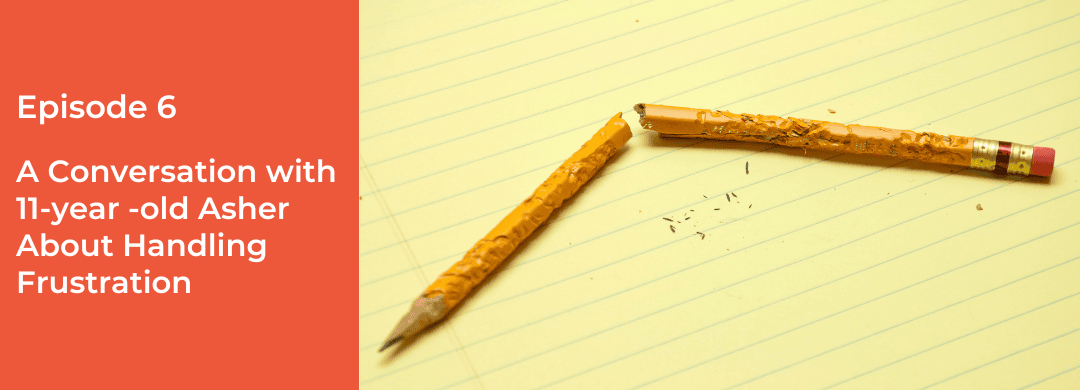
In this special kid’s POV edition, I share a short conversation I had with 11-year-old Asher about being an easily frustrated child. Being easily frustrated is an issue many differently wired kids deal with on a regular basis, and it can lead to challenging situations in the classroom and at home. It’s also a tough one for many parents to know how to handle because frustrations can often seem to come from what we might be perceive to be an overreaction to something. Therefore, it can be harder for us to empathize and support our child through the frustration. Asher and I examine what happened on a day when he made a mistake on an art project. Because he didn’t have a big reaction to something that in the past would have really disrupted his whole experience, I wanted to find out how he processed the frustration without having an explosion.
About Debbie & Asher
 Debbie Reber, MA, is a parenting activist, author of Differently Wired, and founder of Tilt Parenting, a top resource for families raising neurodivergent kids. Through her podcast (8M+ downloads), bestselling books, and speaking, Debbie champions a strengths-based, inclusive approach to parenting. A two-time TEDx speaker and certified Positive Discipline trainer, her work has been featured in The New York Times, The Washington Post, and on NewsNation. Debbie lives in the Netherlands with her husband and two cats, while her neurodivergent young adult (the inspiration for Tilt), attends university in Scotland. Asher recorded this episode at the age of 11.
Things you’ll learn from this episode
- What frustration feels like from a kid’s POV
- Why a child’s frustration can actually be an opportunity to practice having healthier emotional responses
- A resource we’ve tapped into to learn some in-the-moment frustration strategies
Resources mentioned
Want to go deeper?

The Differently Wired Club is not your typical membership community.
There’s something here for everyone, whether you’re a sit back and absorb learner, a hands-on, connect and engage learner, and everything in between. Join the Differently Wired Club and get unstuck, ditch the overwhelm, and find confidence, connection, and JOY in parenting your differently wired child.
Learn more about the Differently Wired Club
Episode Transcript
Debbie
Today’s episode features another short conversation with my 11 year old son Asher. Today we’re talking about frustration, specifically, the kind of frustration that many differently wired kids experience when something they’re working on doesn’t turn out the way they expected. Frustration used to be one of my son’s primary emotions, which isn’t actually unusual or surprising, especially because of his having classic asynchronous development issues stemming from the contrast between his high IQ and his emotional development. I also know that having a low tolerance for frustration is a big part of many differently wired kids’ lives. Frustration can come out in so many different circumstances. But one situation that seems to frequently elicit it is when kids are working on creative and school projects. And they have this picture in their head of what they want to do or create. But what they come up with falls short of their expectations. Also, just to be clear, I realize this kind of situation can be extremely frustrating for neurologically typical kids too, especially those with perfectionistic tendencies. But because with differently wired kids, there can be a pretty huge disconnect between their vision and the final product. Kids who struggle when things don’t go the way they expect can be especially triggered. On top of that the way they express that frustration is very often bigger than their peers, like much bigger. I wanted to ask Asher about frustration because lately I’ve been noticing in him a fledgling ability to kind of roll with the punches. This is very new, and it’s very exciting. During a homeschool project we’ve been working on I realized just how far he’s come.
Debbie
Today, you were working on an architecture art project,
Asher
Why yes, I was.
Debbie
And I noticed that you made some mistakes as you’re working on it. And I made a comment, like, Oh, I didn’t realize you made a mistake, because I didn’t hear a big explosion.
Asher
And I was like, but I told you that I made a mistake.
Debbie
I know it made me kind of notice that. This is kind of new, like there was a time when if you were doing something, and you made a mistake, it didn’t go the way you wanted. You drew a line incorrectly, something happened. So the vision of what you were trying to create suddenly wasn’t turning out the way you hoped. It didn’t go. Well. Do you remember what that used to be? Like? Can you describe to me what it used to be like?
Asher
It used to be like, Ahhh!! Screw the whole day! Stupid mistakes!
Debbie
Asher’s description here is a little understated. The reality is that making a mistake on pretty much anything, a drawing, homework sheet, amaze, really anything was the catalyst for a huge explosion, shouting, shredding, storming and slamming the whole nine yards. But on this day, something very different happened. And just so people know, you were doing an art project. That was an architecture project where you were designing a home. And you chose an architectural…
Asher
I didn’t know it was supposed to be home. I thought it was just a building.
Debbie
Yeah, sorry, a building. You were designing a building, you chose the architectural style of modernism, modernism. And you were using a ruler and pencil and paper…
Asher
And I drew this huge, this huge, sort of crystalline obelisk that was held off the ground by a bunch of like pylons.
Debbie
Yeah, it was very cool looking.
Asher
Yeah, I’ll say…
Debbie
So he was happily working away on his project. And by the way, after happily working away independently on any project is still cause for much joy for this mama. Anyway, he said He made a mistake.
But I did hear you. I was sitting across the room and I heard ‘Oh, like, I made a mistake. That’s not what I wanted.’ And then I heard the eraser. And then you just kept going. And I’m just wondering, because that, you know, even last year wouldn’t have been the case last year, that would have been enough for you to potentially shred the paper and stormed out of the room would have been unfortunate. Yes, do you remember when that used to be the case?
One of the things I spend a lot of time doing with Asher is noticing, and then pointing out to him when he makes a more positive choice when it comes to an emotional response to something. My good friend Alison Bower, who’s one of my guides, and figuring out how to best navigate parenting Asher has trained me to ask reflective questions of Asher so he can learn more about himself and his own process. The goal is to help him continue becoming self aware, and knowing his strengths and weaknesses, so he can start anticipating challenges and know how to better respond to them.
Why do you think you took it so hard when you made mistakes in the past?
Asher
I’m not exactly sure.
Debbie
Would you say that you are a perfectionist?
Asher
Sort of. Like it doesn’t have to be completely 100% perfect. But I can’t do it if it’s bad. It has to be good. Or else I’ll keep trying until it is good.
Debbie
Well, that’s interesting, you say that you’ll keep trying until it is good because…
Asher
Or until I get too infuriated to even be able to work on it. Right? And that’s one small problem.
Debbie
I was curious to know if Asher notices the difference himself, or if he knew what changed for him, if he knew why today. And actually more and more lately, he’s moving through frustration in a healthier, more useful way. I asked him if you had any ideas.
What has changed for you? Or what feels different for you that’s preventing you from having that big explosion of frustration?
Asher
I’m not exactly sure. Part of it is that I’d rather not destroy my own work.
Debbie
Does it feel different for you?
Asher
It feels better.
Debbie
Can you describe what’s going on in your mind?
Asher
That’s, like, I made a mistake. Well, that’s what erasers are for. Erase, erase, erase.
Debbie
Did you start to get upset but then you caught yourself and prevented the explosion from happening or … I’m just kind of curious what helped you have a different response?
Asher
I was a teeny bit upset. But then I stopped myself. Like I wasn’t going to have an explosion.
Debbie
And so what was the outcome then for you?
Asher
Then I ended up having a faint pencil line. Is that okay? I wasn’t where I wanted it. Yeah, it’s fine.
Debbie
Are you still going to complete the project? Do you feel like it’s ruined because I don’t go to complete the project?
Last year, Asher and I had read through this great book called What to Do When Your Temper Flares: A Kid’s Guide to Overcoming Problems with Anger by Dawn Huebner and Asher learned about different strategies for defusing anger and frustration in the moment. I reminded Asher of the book we’d read and I asked him if he’d stopped himself from getting super upset by changing the voice in his head to something less negative.
Asher
Because, yes, but I’m not like, I’m not consciously like, This mistake is completely fine cuz I have an eraser. I’m just like, that’s fine. I’m gonna erase. It’s a logical conclusion instead of a conscious thought.
Debbie
And it’s also not an emotional reaction, which it used to be always emotional.
Asher
Right.
Debbie
Right. So I guess I’m curious to know, do you feel like the way that you used to have those big explosions if things didn’t go your way, especially on something you were creating? Do you think those days are behind you? Or do you think it was just your mood today?
Asher
Um, I think they’re behind me.
Debbie
I’m not sure if the explosions are totally behind Asher. But they are so unusual these days that my husband and I are almost shocked when they do happen. And considering they used to be a daily occurrence, sometimes multiple times per day. To say this is progress would be a huge understatement. It’s interesting. I used to want to avoid situations where Asher had the potential to get frustrated mostly because I would have done anything to avoid the explosion I knew would invariably follow. But now, I’m fine with it. In fact, I’d even say that I welcome the frustrations, because now I look at them as opportunities to practice moving through frustrating situations without totally losing it and building that muscle in his brain. And let’s face it appropriately managing frustration is a skill pretty much every human on the planet could use. Asher included myself included.
Debbie
So what’s your plan for finishing up the project then? Just curious.
Asher
Well, eventually I want to get some sort of architecture, 3d modeler tool thingy, and actually build it.
Debbie
Right. That sounds pretty cool. I would like to see that too. Alright, thank you, Asher.
Asher
You’re welcome.